B minor
B · D · F♯
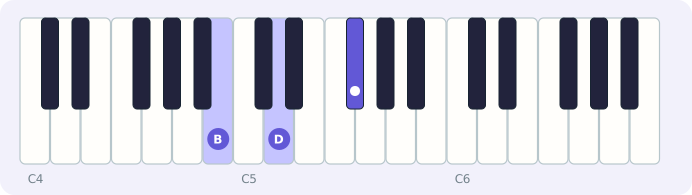
See which notes your chords share, which notes move, and how each harmony sounds. Build a smoother piano chord transition. When you arrive from an individual lesson, both chords are already selected for you.
B · D · F♯
E · G · B
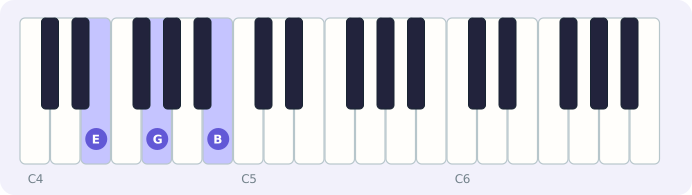
Pick two chords to compare their pitch classes and learn a simple note-moving exercise.
Use the selectors above to hear each pair. Then look for notes that can stay in the same place while just one voice moves.
B minor uses B–D–F♯. D major uses D–F♯–A. They share D and F♯, so one voice can change from B down to A while the other two remain. That makes a useful beginner exercise in economical voice leading.
C7 uses C–E–G–B♭, while Cmaj7 uses C–E–G–B natural. Keep C, E and G in place and move B♭ up one semitone to B. The sound changes even though the root, third and fifth are identical.
The compare tool checks the sounding pitch classes. For two chords in different octaves, the shortest physical finger movement may differ from the root-position diagrams. Use the inversion explorer to choose a comfortable voicing.