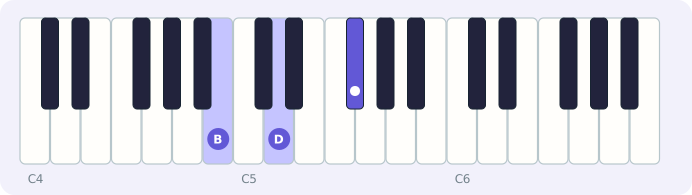
Learn the shapeHow to play Bm on piano
First, find B, the root of this chord. Then add D, the minor third. Add F♯ to complete the triad.
Play the notes together to hear the harmony, or one at a time to hear how the intervals form the chord. Start at a comfortable octave; the diagram shows one reference voicing, not the only valid place to play it.
What makes Bm distinctive?
B minor feels settled in its own key yet can sound reflective beside D major. Its F♯ is the note that distinguishes the chord from a simple B–D interval.
How does Bm compare with a related chord?
Compare Bm with D major (D–F♯–A): D and F♯ remain in both chords, while B moves to A. Listen for how two stable notes let the change feel smooth.
A practice exercise for Bm
Play B–D–F♯ slowly, then switch to D–F♯–A without releasing D and F♯. Notice that only one note needs to move.
One mistake to avoid
Do not substitute F natural for F♯. B–D–F is a different diminished-triad sound.
Finger numbers depend on your hand size, octave and musical context; there isn't one universally correct fingering for every voicing.