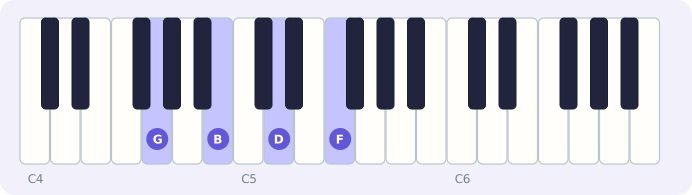
Learn the shapeHow to play G7 on piano
First, find G, the root of this chord. Then add B, the major third. Add D to complete the triad. The fourth note, F, is a minor seventh above the root.
Play the notes together to hear the harmony, or one at a time to hear how the intervals form the chord. Start at a comfortable octave; the diagram shows one reference voicing, not the only valid place to play it.
What makes G7 distinctive?
G7 (G–B–D–F) is the dominant seventh built on G. The B–F interval forms a tritone whose notes commonly resolve by semitone to C and E when the harmony moves to C major. It is different from Gmaj7, which would use F♯.
How does G7 compare with a related chord?
Compare G7 with G major (G–B–D) to hear the added F. Then compare G7 with Cmaj7 (C–E–G–B): G and B remain common tones, while F moves to E and D can move to C. This is the clear V7–Imaj7 move in C major.
A practice exercise for G7
Play G–B–D, add F, then stop on Cmaj7 (C–E–G–B) for four beats. Try a reduced G7 shell of B and F; move B up to C and F down to E. Finally practise the full Dm7–G7–Cmaj7 cadence at 60 BPM before speeding up.
One mistake to avoid
G7 means G–B–D–F, not G–B–D–F♯. The latter is Gmaj7. Do not interpret the plain '7' symbol as a major seventh.
Finger numbers depend on your hand size, octave and musical context; there isn't one universally correct fingering for every voicing.