PLAY · LISTEN · DISCOVER88 piano keys · 120 chords · Free
THE CHORD ATLAS / MAJOR SEVENTH

C major seventh piano chord

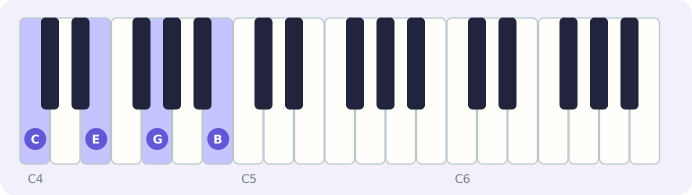
The Cmaj7 chord is built from C – E – G – B. See the exact keys, hear how they sound together, and explore how the chord changes when you move its lowest note.

4 notes4 voicingsFree to play & print
QUICK REFERENCE · EXACT NOTES

What notes are in the C major seventh piano chord?

C major seventh (Cmaj7) is a major seventh containing C, E, G and B. Its interval formula is root, major third, perfect fifth and major seventh.

What are the inversions of Cmaj7?

Cmaj7 has 4 positions: root position (C–E–G–B), first inversion (E–G–B–C), second inversion (G–B–C–E) and third inversion (B–C–E–G). Each inversion contains the same chord tones but puts a different note in the bass.

These are reference note spellings in twelve-tone equal temperament, not fixed fingerings. See the keys, hear each voicing, or learn chord spelling.

Interactive keyboard

Cmaj7 Major seventh

Selected notes: C – E – G – B

12-tone equal temperament
C major seventh keyboard diagram showing C – E – G – B
↓ Save SVG
Change the bass

Explore the inversions

All inversions use the same pitch classes. Moving the bottom note up an octave changes the voicing, not the chord identity.

Explore Cmaj7 across all voicings ↗

Root position: C · E · G · B

Lowest note: C. Each higher note is placed above the previous one.

C major seventh piano keyboard, root positionHighlighted piano keys: C · E · G · B.CC4EGBC5C6
Learn the shape

How to play Cmaj7 on piano

First, find C, the root of this chord. Then add E, the major third. Add G to complete the triad. The fourth note, B, is a major seventh above the root.

Play the notes together to hear the harmony, or one at a time to hear how the intervals form the chord. Start at a comfortable octave; the diagram shows one reference voicing, not the only valid place to play it.

What makes Cmaj7 distinctive?

C major seventh (C–E–G–B) builds on the familiar C major triad and adds B natural, a major seventh above C. The half-step between B and the next C makes it feel gently unfinished rather than demanding an immediate resolution.

How does Cmaj7 compare with a related chord?

Put Cmaj7 beside C7 (C–E–G–B♭). Both keep C, E and G; the only difference is the seventh, B versus B♭. Then compare Cm7 (C–E♭–G–B♭) to hear how changing the third adds a second, independent change.

A practice exercise for Cmaj7

Play the three-note C–E–G triad and hold it for two counts. Add B to make Cmaj7, then release only B. Repeat with B♭ to make C7. Next play Dm7–G7–Cmaj7 slowly, four beats per chord; notice B stays in G7 and Cmaj7.

One mistake to avoid

The word 'maj7' refers to the seventh interval as well as the major triad. Cmaj7 uses B natural; C7 has B♭. Never substitute C7 when a chart explicitly says Cmaj7.

Finger numbers depend on your hand size, octave and musical context; there isn't one universally correct fingering for every voicing.
A TWO-CHORD EAR-TRAINING CHALLENGE

Hear Cmaj7 become C7

First play C–E–G–B, then C–E–G–B♭. Keep the first three voices steady; focus on the top note. Can you hear the difference between the two kinds of seventh?

Show the answer: which notes stay or move?

The root C, third E and fifth G are identical. Only the seventh changes: B natural lowers one semitone to B♭. Cmaj7 contains a major seventh above C; C7 contains a minor seventh and usually functions as a dominant chord.

Play each button after the previous sound fades. The exercise checks your listening; it does not record or score your performance.

Keep exploring

Related piano chords