Learn the shapeHow to play C on piano
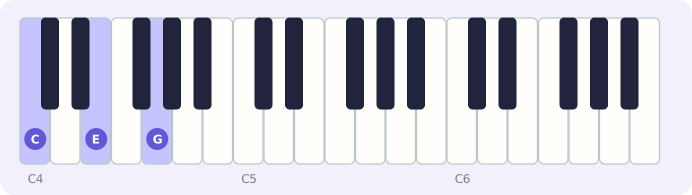
First, find C, the root of this chord. Then add E, the major third. Add G to complete the triad.
Play the notes together to hear the harmony, or one at a time to hear how the intervals form the chord. Start at a comfortable octave; the diagram shows one reference voicing, not the only valid place to play it.
What makes C distinctive?
C major is often the first piano chord students encounter because its three notes, C–E–G, are all white keys and form an easy visual landmark.
How does C compare with a related chord?
Compare C major to A minor (A–C–E). C and E are shared, while G moves up to A; this gives an accessible first harmony exercise.
A practice exercise for C
Play C–E–G, then keep C and E steady while moving G up to A. Reposition A below C and E to hear A minor in root position; the original G-to-A move alone gives a different voicing. Name each chord tone before you play.
One mistake to avoid
C major chord is not the same search task as the chords found inside the C major scale. A chord is three specific notes; a key contains several harmonies.
Finger numbers depend on your hand size, octave and musical context; there isn't one universally correct fingering for every voicing.