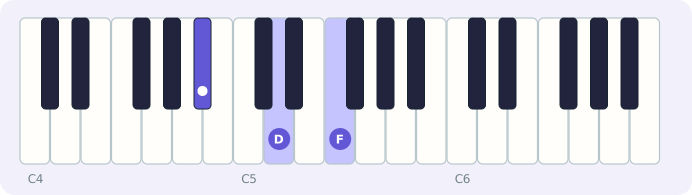
Learn the shapeHow to play B♭ on piano
First, find B♭, the root of this chord. Then add D, the major third. Add F to complete the triad.
Play the notes together to hear the harmony, or one at a time to hear how the intervals form the chord. Start at a comfortable octave; the diagram shows one reference voicing, not the only valid place to play it.
What makes B♭ distinctive?
B♭ major is a common home chord in brass and wind repertoire. On piano it pairs two white keys, D and F, with the black-key root B♭.
How does B♭ compare with a related chord?
Compare it with G minor (G–B♭–D). The B♭ and D can stay in place while F moves to G, making it easy to hear their relationship.
A practice exercise for B♭
Find B♭ with your eyes closed, then locate D and F by their interval distances. Switch to G minor by keeping B♭ and D held.
One mistake to avoid
Write the root as B♭ in this chord, not A♯. Equal-tempered sound alone does not determine the correct chord spelling.
Finger numbers depend on your hand size, octave and musical context; there isn't one universally correct fingering for every voicing.