PLAY · LISTEN · DISCOVER88 piano keys · 120 chords · Free
THE CHORD ATLAS / MAJOR

E major piano chord

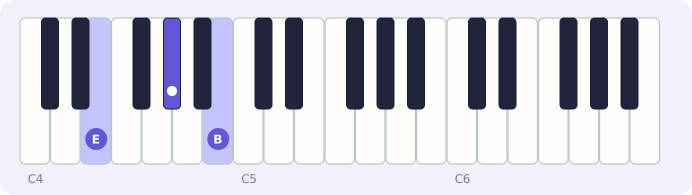
The E chord is built from E – G♯ – B. See the exact keys, hear how they sound together, and explore how the chord changes when you move its lowest note.

3 notes3 voicingsFree to play & print
QUICK REFERENCE · EXACT NOTES

What notes are in the E major piano chord?

E major (E) is a major triad containing E, G♯ and B. Its interval formula is root, major third and perfect fifth.

What are the inversions of E?

E has 3 positions: root position (E–G♯–B), first inversion (G♯–B–E) and second inversion (B–E–G♯). Each inversion contains the same chord tones but puts a different note in the bass.

These are reference note spellings in twelve-tone equal temperament, not fixed fingerings. See the keys, hear each voicing, or learn chord spelling.
Interactive keyboard

E Major

Selected notes: E – G♯ – B

12-tone equal temperament
E major keyboard diagram showing E – G♯ – B
↓ Save SVG
Change the bass

Explore the inversions

All inversions use the same pitch classes. Moving the bottom note up an octave changes the voicing, not the chord identity.

Explore E across all voicings ↗

Root position: E · G♯ · B

Lowest note: E. Each higher note is placed above the previous one.

E major piano keyboard, root positionHighlighted piano keys: E · G♯ · B.C4EBC5C6
Learn the shape

How to play E on piano

First, find E, the root of this chord. Then add G♯, the major third. Add B to complete the triad.

Play the notes together to hear the harmony, or one at a time to hear how the intervals form the chord. Start at a comfortable octave; the diagram shows one reference voicing, not the only valid place to play it.

What makes E distinctive?

E major has the notes E–G♯–B. Its bright quality comes from the raised third G♯ compared with E minor.

How does E compare with a related chord?

Play E major and E minor alternately. Both contain E and B; G♯ becomes G to create the minor quality.

A practice exercise for E

Keep E and B held while slowly moving G♯ to G and back. Name the interval change with each move.

One mistake to avoid

An E major chord contains G♯, not G natural. Listen to that half-step difference.

Finger numbers depend on your hand size, octave and musical context; there isn't one universally correct fingering for every voicing.

A TWO-CHORD EAR-TRAINING CHALLENGE

Hear E become Em

Hold E and B, then alternate E–G♯–B with E–G–B. Which black key turns into a white key?

Show the answer: which notes stay or move?

G♯ falls one semitone to G natural. E and B do not move. The third, not the root or fifth, changes the chord from major to minor.

Play each button after the previous sound fades. The exercise checks your listening; it does not record or score your performance.

Keep exploring

Related piano chords